
After the "elections" – negotiations? What lies behind Moscow's signals?
US negotiators speak of a "new readiness" on Russia's part for dialogue. Why do experts doubt a quick turnaround, what lies behind the surge in diplomatic activity, and what role has been assigned to Europe in this?
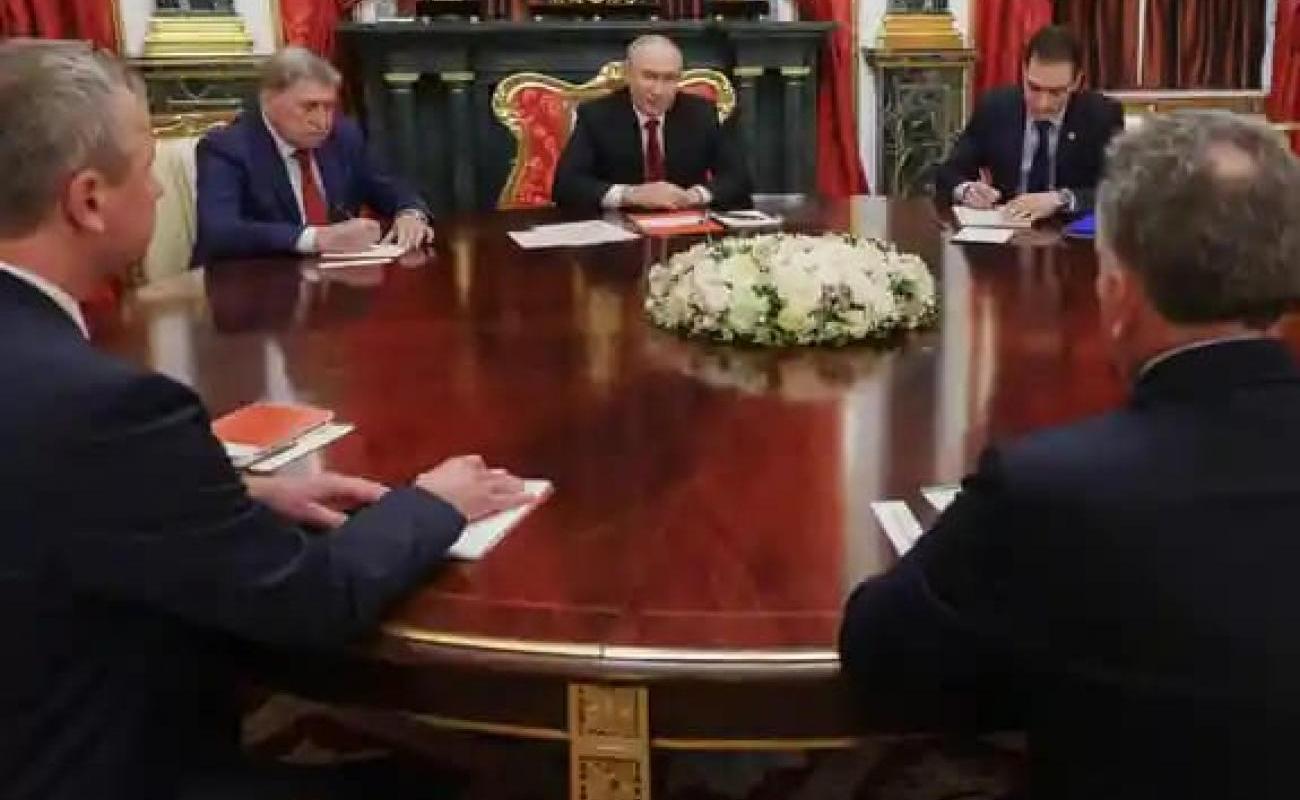
The topic of possible negotiations to end Russia's war against Ukraine has regained prominence after a months-long hiatus. A US delegation—comprising US Presidential Special Envoy Steve Witkoff and Donald Trump's son-in-law Jared Kushner—visited Moscow on September 5, where they held talks with Russian President Vladimir Putin, before arriving in Kyiv the following day.
There, the Americans met with Ukrainian President Volodymyr Zelenskyy and other Ukrainian government officials. National security advisors from France, Germany, and the UK also joined the consultations.
As a source from the Élysée Palace further told reporters, the Americans briefed their European partners in Kyiv on the results of the talks with Putin, on Russia's "new readiness for negotiations" following the State Duma elections, and on the need to prepare for a "fresh start" to the negotiation process.
After the "election" - to the negotiating table?
What exactly this "new beginning" could mean is still not clear. Possible conditions for the continuation of negotiations have not been determined, and their parameters have not been specified by the American side. A source from the Elysée Palace also could not answer the question of whether Moscow's demands had changed. At the same time, according to him, Putin's current conditions for a meeting with Zelensky remain unacceptable.
In Brussels, the new momentum of diplomatic efforts was welcomed, but the prospects for negotiations were assessed cautiously.
"We need Russia's readiness, which we obviously don't see now," said Christian Wiegand, representative of the European Commission, on September 8.
According to him, the EU should continue the pressure of sanctions on Russia and support Ukraine in order to encourage Moscow to negotiate honestly and strive for a just and lasting peace.
Why does Washington need negotiations now?
However, the increase in diplomatic activity does not mean that the parties have come closer to an agreement: experts interviewed by DW stress that each of the participants in the process has their own reasons for expressing interest in negotiations.
According to security expert Roland Freudenstein, co-founder of the Brussels Freedom Hub think tank, the Trump administration has its own political interest in continuing negotiations.
"The US government is interested in reaching some kind of agreement or at least the appearance of an agreement before the midterm elections, because Trump wants to be seen as a peacemaker," he said in an interview with DW.
But Russia, according to the expert, is pursuing another goal, completely unrelated to the planned elections there. Putin is trying to distance Washington from Kiev as much as possible. But since he has not yet managed to completely end US support for Ukraine - the US provides intelligence and sells weapons, paid for by the Europeans - the Russian president is constantly fueling the Trump administration's hopes for a possible compromise, Freudenstein believes.
"He still maintains the illusion that he is about to compromise. But he hasn't compromised for four and a half years and he won't compromise as long as he believes he will win. And he believes in it," says the analyst.
Kiev, too, has its own interests in this "triangle game," as Freudenstein calls it: to keep distance between Trump and Putin and show Washington that the obstacle to achieving peace is not Ukraine. According to experts, Kiev has already made significant concessions in relation to its 2022 negotiating position and is now seeking to show what the next step should be for Russia.
Is Moscow ready for a compromise?
All the experts interviewed by DW are skeptical about the prospects for significant progress in negotiations and, for the time being, see no signs that Moscow is actually prepared to change its stance. "I am extremely skeptical about the prospects for peace talks with America, and even more so with European participation," says Arkady Moshes, Director of the EU-Russia Eastern Neighbourhood Research Programme at the Finnish Institute of International Affairs (FIIA).
According to him, Russia's public stance remains "extremely radical," and Putin "emphasizes in every way that he will win the war, not a diplomatic battle."
The expert believes that in any potential negotiations, Moscow will rely primarily on the outcomes of hostilities and escalation.
"For now, I see no basis for serious negotiations," Moshes concludes.
The assumption that a new window for negotiations might open after the State Duma elections is wishful thinking, according to Julian Romanišin, a senior researcher at the Center for Advanced Security, Strategic and Integration Studies (CASSIS) at the University of Bonn. In his view, these elections will change nothing in Russian policy, as key decisions do not depend on their results.
Freudenstein, for his part, draws attention to the lack of concrete substance in the signal being conveyed by the Americans.
"The question arises: what is the meaning here?" the analyst says.
According to the expert, Putin has no reason to change his stance in the coming months. "In the long run, that is a different matter," Freudenstein adds.
What role has been assigned to Europe in the new negotiations?
A new element of current diplomatic activity is the direct participation of the so-called "E3"—France, Germany, and the United Kingdom—in consultations between the United States and Ukraine. The Élysée Palace emphasized that the US-Ukraine-E3 format was established in this configuration for the first time and expressed confidence that Europeans would remain involved in the negotiation process.
"Objectively, Europe's role in providing military support to Ukraine today is of paramount importance; indeed, it is decisive," notes Moshes.
Europeans are paying for US arms shipments to Ukraine and are also bearing a significant share of the costs associated with supporting the Ukrainian budget. At the same time, according to experts, "their role in a diplomatic solution clearly does not match their role in the actual course of the war."
Romanišin considers the participation of the E3 in these talks to be one of the most significant outcomes of the consultations in Kyiv. According to him, this format allows for the representation of European interests without overburdening potential negotiations with an excessive number of participants. Furthermore, the E3 already possesses experience in joint diplomacy—France, Germany, and the UK participated in negotiations regarding the Iranian nuclear program.
The selection of these three countries also holds practical significance, Romanišin adds: Germany is the primary supplier of military aid to Ukraine, while France and the UK are leaders of the "coalition of the willing" currently developing security guarantees for Ukraine. According to a political expert, it makes sense to consolidate the E3's participation in potential negotiations during the later stages of the process.
However, even despite all that, "Russia does not believe that Europe can—or, moreover, should—be an equal participant in these negotiations," notes Moshes.
The E3 Is Not Yet the European Union
Is the participation of the E3 sufficient for Brussels, or does the European Union expect to have its own representative at the table for potential negotiations? European Commission spokesperson Christian Wiegand did not give a direct answer to this question.
However, he emphasized that the European Union is in constant contact with all key stakeholders and is "ready to play its part" in finding a diplomatic solution. According to Wiegand, the European Union is directly involved in issues concerning Ukraine's security, its reconstruction, and future EU membership, as well as the sanctions policy against Russia.
Exactly what form EU representation will take in a potential new negotiation process remains an open question.
What leverage does Europe have?
However, mere presence at the negotiating table does not guarantee influence over the outcome. According to Romanišin, Europeans possess a range of tools they can use to increase pressure on Moscow and make it willing to engage in serious negotiations.
The expert identifies Russian assets frozen in the EU—a significant portion of which are located in Belgium—as one such lever. In his view, the mere threat of confiscating these assets could serve as a tool to pressure the Kremlin; should that prove insufficient, the assets ought to be confiscated and used to support Ukraine. Another tool involves further strengthening sanctions, particularly against Russia's "shadow fleet" and companies in third countries that help Moscow circumvent restrictions.
Romanišin also believes it is essential to continue military support for Ukraine—specifically by helping to develop its long-range strike capabilities—and cites future security guarantees as yet another lever. Indeed, a "coalition of the willing" is considering the deployment of multinational forces in Ukraine following a ceasefire, whereas Moscow categorically opposes such a military presence.
Moshes also believes that European capabilities extend beyond merely funding Ukraine. He lists technology, military presence (or the withdrawal thereof in the event of peace), surveillance, and diplomatic support among the potential tools available.
"Will it play out one way or the other? There is no point in speculating today," the expert concludes.