
A new phase of the war in Ukraine. Experts on the attacks of the Ukrainian armed forces deep into the Russian Federation
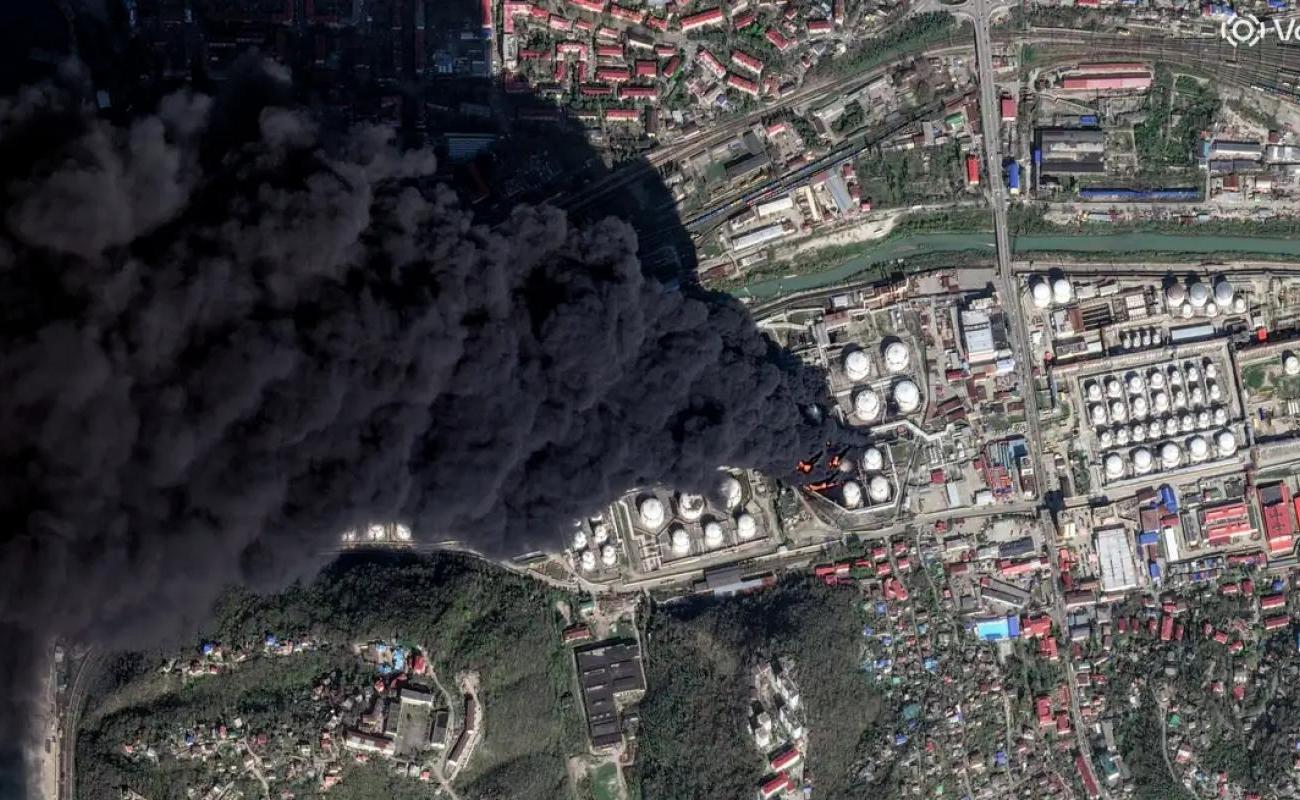
Retaliatory attacks by Ukrainian drones on objects in the territory of the Russian Federation and periodic failures of air defense systems - is this a long-term trend? What does this mean and how does it affect the course of the war? DW spoke to military experts.
Kiev has begun to respond to the long-term strikes of the Russian army with missiles and drones, which destroy the civilian infrastructure of Ukraine and lead to casualties among the civilian population, with intensified attacks by drones, which are increasingly hitting targets in the territory of the Russian Federation. How did this become possible, what is the current situation on the front in Ukraine and why do observers consider what is happening to be a new phase of the war? DW answered these and other questions from political and military experts.
Why has Ukraine intensified drone attacks on Russian regions
According to military expert Markus Reisner, a colonel in the Austrian armed forces, the war is "shifting".
"Today, Kiev is waging war at a strategic level and, unlike in recent years, when Russian airstrikes on Ukraine were actually strategically dominant, it is able to respond quickly to Russian airstrikes," Reisner says.
"Why is this possible? From my perspective, Ukraine has learned a lot in recent years and, despite some withdrawal of American involvement, has managed to find allies in Europe who are helping it produce enough drones to launch effective attacks on Russia," Reisner continues. "Ukraine needed to build up the capacity to launch effective attacks. This means that the country can launch more drones than the other side, in this case Russia, can repel with its air defense system," Reisner believes.
Israeli military observer David Sharp makes a similar observation, specifying that the Ukrainians "did not simply accumulate forces."
"They have established mass production of a wide range of drones, and the results of this are reflected in the scale of the strikes. This is not a temporary phenomenon," the military expert is convinced.
At the same time, Sharp notes that the tactic of using drones to stop the advance of enemy troops, which the Ukrainian armed forces have begun to actively resort to, is not new. “Drones have long become the main means of defeat on the front for both sides,” Sharp explains. “But since the Russian army is attacking more actively, it has more infantry involved, and accordingly, there are more targets for the Ukrainians.”
According to his assessment, the active use of drones by the Ukrainian army “is not always due to the good life,” but because the Ukrainian armed forces do not have their own infantry and high-quality, numerous aviation.
“And drones are quite effective in the current conditions and are available for mass production of weapons, and they are used to their full potential,” says David Sharp.
Russian oil refineries as a "legitimate target" for Ukraine
From the point of view of Volodymyr Fesenko, an expert from the Ukrainian Center for Applied Political Research "Penta", for Kiev, the active use of drones for attacks on the regions of the Russian Federation, that is, "asymmetric warfare, the transfer of war to the territory of Russia" is one of the main methods of countering Russian aggression.
"For us, this is a very important part of the war. After all, we cannot compete with Russia in resources, despite European support for our country," Fesenko emphasizes.
"The fact that the Russians themselves are experiencing this war is, rather, a side effect. But purely psychologically, it is very significant," the expert adds, agreeing that the air strikes of the Armed Forces deep into Russian territory, which have become more frequent, indicate the beginning of a new phase of the conflict.
As Fesenko reminds us, the main targets of Ukrainian attacks on Russian territory are military facilities "that produce missiles that then hit Ukraine," as well as oil infrastructure facilities, such as refineries.
"The main income that allows Russia to continue the war is income from oil sales. Therefore, this is a legitimate target for Ukraine," says Fesenko.
According to him, "one of the most attractive targets for Ukraine in the future" is "Alabuga" - a special economic zone where Russian drone production enterprises are located. In addition, it is important for Kiev to attack ports in the Baltic Sea, because most of Russia's oil exports go through them, as well as facilities of military importance near Moscow and St. Petersburg, DW's interlocutor points out.
A similar opinion is expressed by Austrian army colonel Markus Reisner.
"The Russian narrative is that this war is taking place somewhere far away and does not concern us. And it certainly does not affect the residents of Moscow or St. Petersburg in any way. But this statement no longer looks convincing, especially if Ukrainian drones start striking as they did (Russian drones. - Editorial) in Ukraine."
Why is the Russian air defense system unable to cope with Ukrainian drones?
Increasingly, the Russian authorities are reporting on the destruction of Ukrainian drones already on the approaches to Moscow or near other cities of the Russian Federation. Why is the Russian air defense system unable to cope? "There are enough objective and subjective reasons," comments Israeli military expert David Sharp. "First, it is not the most advanced material and technical part. Despite all the propaganda, the Russian air defense assets in the complex are not the pinnacle of technology. Moreover, they were created not to fight drones, but against classic targets."
Secondly, the role is played by the not very good training of the personnel and command of the Russian armed forces, he continues. "The lack of air defense assets is also a serious problem that not only Russia, but also the USA, Saudi Arabia or Ukraine are facing," the expert says.
As Sharp notes, the production of air defense weapons is not only expensive, but also a technically complex process, "and Russia spends a lot on air defense weapons, including drone decoys".
Due to the combination of these factors, the Russian air defense system looks like "Tryshkin's captain," continues DW's interlocutor.
"Once drones cross the border, overcoming the first line of defense, they are very difficult to pursue from the ground," Sharp says. Meanwhile, despite relative successes, the Armed Forces of Ukraine also have problems, Sharp reminds, pointing in this regard, first of all, to the number of personnel, as well as the quality of use and the number of reservists.
According to his observations, Russia is now trying to accumulate resources in order to increase pressure and achieve greater results in the summer campaign.
"After all, what was achieved in the spring campaign clearly did not meet the requirements and hopes of the Russian command and Putin personally."
The Russian leadership "will not give up the idea of \u200b\u200btaking Donbass and, say, something else that their hands can reach," - he predicts. Therefore, there will certainly be attempts to increase pressure on key areas of the front.
Wait for the escalation of the war or peace negotiations?
For his part, Volodymyr Fesenko believes that the Kremlin has two alternatives in the face of a stalemate on the front. The first is to gradually begin real negotiations on the cessation of hostilities through a pragmatic compromise.
"And the second option is very risky. This is an escalation of the war, associated with mass mobilization. But this can intensify the already crisis trends in Russia: public discontent, war fatigue," adds Fesenko.
According to the Ukrainian political scientist, Moscow is also considering another option: "try to attack neighboring European countries, perhaps in a hybrid form, and thus test NATO for strength and scare Ukraine's Western allies so that they refuse to support Kiev and make concessions to Russia."
"But any of these methods is very risky. Therefore, I think that the Kremlin has not yet made a final decision and is betting on continuing the attack on Ukraine in the summer, hoping that it will break, and only then, in the fall, decide on further actions," summarizes Volodymyr Fesenko.