
"Will the North Crimean Canal be 100 percent water-rich"? How will Crimea cope with water shortages in 2026
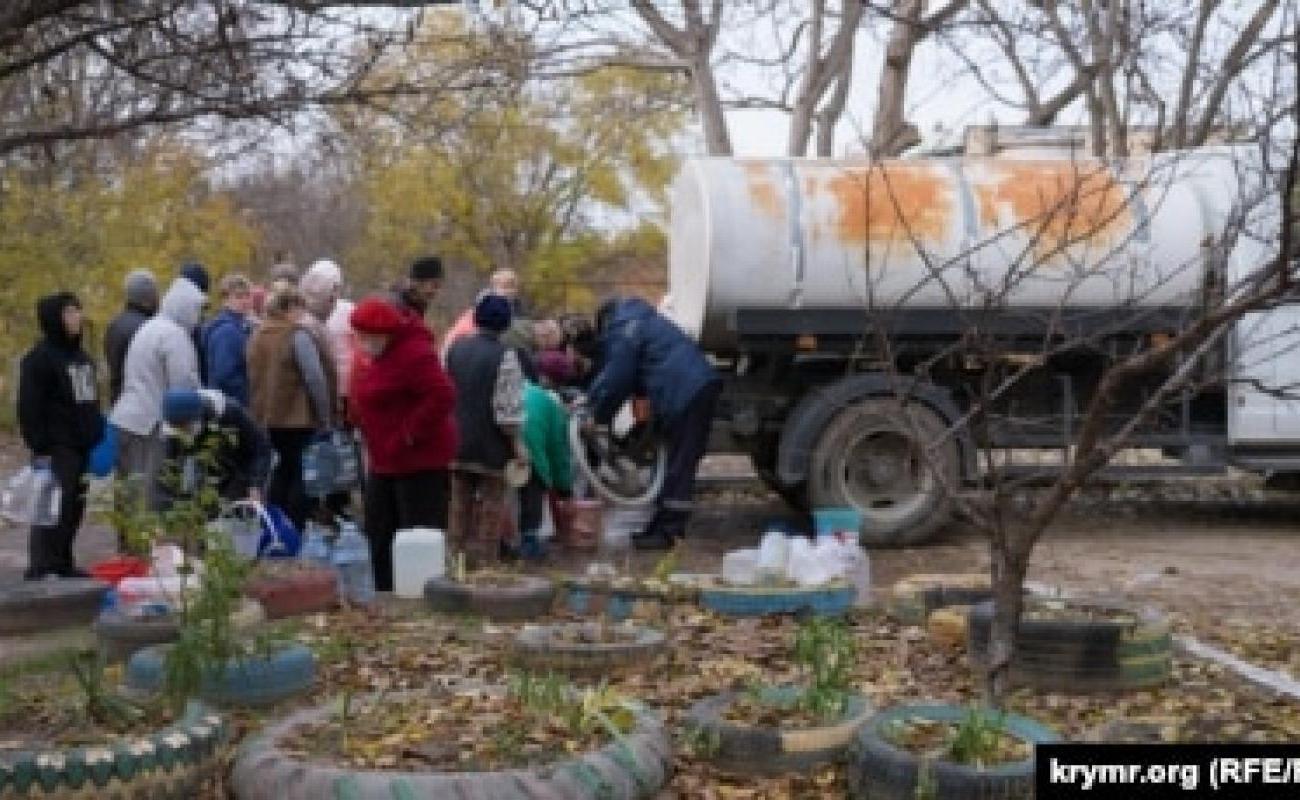
The problem of water shortages in the annexed Crimea will last throughout 2026. Entire Crimean regions will be left without water, local authorities under the control of the Russian Federation admit. As before, the needs of the local population are expected to be met by the exploitation of underground sources. But the North Crimean Canal is also being prepared for operation. Where can Crimea expect water from, we talk in the Crimea.Realities material.
In recent years, Crimea has been experiencing a period of drought, when natural precipitation cannot replenish local water sources. The lack of water from the Dnieper exacerbates the problems in various areas. Most likely, it will continue this year.
“Water in 320 days”
The Russian authorities of Crimea expected that the Crimean reservoirs would be filled with precipitation in the autumn-winter period. But the autumn of 2025 did not meet these expectations. And in fact, the natural springs of Crimea were filled with water only in January-February 2026. They are currently half full, said the head of the State Committee for Water Management and Reclamation of the Russian government of Crimea, Roman Zakharov.
“About 103 million cubic meters of water have entered the natural runoff reservoirs of Crimea. This is about 55 percent of the full design volume of these reservoirs. This is our main reserve, which we use to supply the population and sectors of the Crimean economy. Based on this, we can say that for 320 days we are guaranteed to meet the needs of the population with the existing volumes of water consumption,” he said at a briefing in Simferopol.
Eastern Crimea is traditionally considered the area with the greatest water deficit, the needs of which are met by local rivers, which dry up significantly in the summer.
In 2025, water barrels were installed in the southern and eastern regions of the Crimean peninsula for the technical needs of the population. As of autumn, according to official data, 77 regions of Crimea live on imported water.
Last year, Velika Alushta was in a difficult situation. For several months, it was supplied with imported water, and in the fall and winter, the local population received water by the hour.
Since the beginning of 2026, the situation in this region has stabilized, claims Roman Zakharov. He assured that Velika Alushta is "guaranteed to have water for 156 days." At the end of this period, the region will be in the midst of summer, the main resort season, when the need for water increases significantly.
A blow to agriculture
In recent years, the Russian authorities in Crimea have been actively digging wells to meet the region's needs for water from underground sources. This has led to the massive depletion of aquifers, resulting in the appearance of salt water in the taps of Crimean residents.
After that, many wells have been preserved. And the only hope for Crimea remains local rivers and reservoirs. The Russian authorities in Crimea promise to begin updating the technical water supply networks in 2026, repairing old water pipes and pumping stations. Such work is planned, in particular, in the Leninsky, Bakhchisaray and Simferopol districts.
In conditions of water shortage in Crimea, the spheres of industrial production and agriculture traditionally suffer. Agriculture has survived for years thanks to subsidies from the federal budget. Last year, a state of emergency was declared in Crimea several times due to drought.
The Russian authorities in Crimea expect to receive almost three billion rubles in support of agricultural production in 2026. Among the most subsidized industries are viticulture, horticulture and essential oils.
The State Committee for Water Resources and Irrigation promises to provide 30 million cubic meters of water for irrigation of agricultural land this year. Before Russia annexed Crimea and the cessation of the region’s water supply from the Dnieper, more than 100,000 hectares of agricultural land were irrigated there.
“North Crimean Canal to operate year-round”
The facilities of the North Crimean Canal will be used to supply Crimea with water. Water is transported to it from the Belogorsk and Taigan reservoirs via the Biyuk-Karasu River and delivered to consumers in eastern Crimea.
This hydraulic structure continues to be used, even in the absence of water from the Dnieper. The North Crimean Canal is ready to receive water from the Dnieper, local officials claim.
They are counting on this, despite the fact that the possibility of supplying the Dnieper with water was lost for an indefinite period due to the destruction of the Kakhovka hydroelectric power station dam in the occupied part of the Kherson region by Russian troops in 2023.
“147.7 kilometers of the North Crimean Canal facilities have been in operation year-round since 2014. There is no water inflow from the Kakhovka reservoir. But the condition of all facilities is maintained in operational readiness. All necessary repair work is being carried out on all branches of the North Crimean Canal. Now we have switched to internal sources of water supply. But this does not mean that this canal will not be fully operational in the future. After the successful completion of the objectives of the “SVO” (as the Russian Federation calls its full-scale invasion of Ukraine - KR), water from the Dnieper River will again flow into the North Crimean Canal. We are ready to receive this water. "We will do everything possible to make this water available again for greater economic efficiency and development, primarily agriculture," says Roman Zakharov, head of the Russian State Committee for Water Resources and Reclamation of Crimea.
It has already been decided to "start reconstruction" of the Kakhovka reservoir dam, but they want to do this after the Russian Federation's full invasion of Ukraine is over, Vladimir Konstantinov, chairman of the Russian parliament in Crimea, previously said.
The Russian head of Crimea, Sergei Aksyonov, also promised to restore water supplies from the Dnieper through the North Crimean Canal.
“I am sure that the water in the canal will be 100 percent. The problem is technically complicated today only by the fact that the Dnieper coast is under shelling, under the influence of enemy fire. As soon as the goals set by the President (Russian Federation Vladimir Putin - KR) are achieved, it will be possible to supply water to the North Crimean Canal. Technical issues have been considered and there is already a project on how to do this. I do not see any problems here. This is a temporary situation,” he said in an interview with Russian television in August 2025.
In the almost 12 years since the annexation of Crimea, the Russian government has promised many global water supply projects for Crimea - from desalination of sea water to artificial precipitation. But none of them have been implemented.
After the Russian military captured the Kakhovka hydroelectric power station in February 2022 and subsequently destroyed the facility, the Russian authorities promised to build additional reservoirs in Crimea to store local water resources. It is planned to build one of them on the Marta River in Bakhchisaray District, and the other on the Shhidna Ulu-Uzen River near the village of Sonjachnogorsk in Velika Alushta. However, it is not expected to be operational until 2030. Until then, the problem of water shortage in Crimea will remain present, as before.